

Customers usually quit an online service booking at one of a few predictable spots; a button they can’t find, a form that does or asks too much, a calendar with no times that fit, and more. Most of those steps come built into the scheduling system and stores usually can’t control much change. But what a store can change is the booking experience customers see in front of that system.
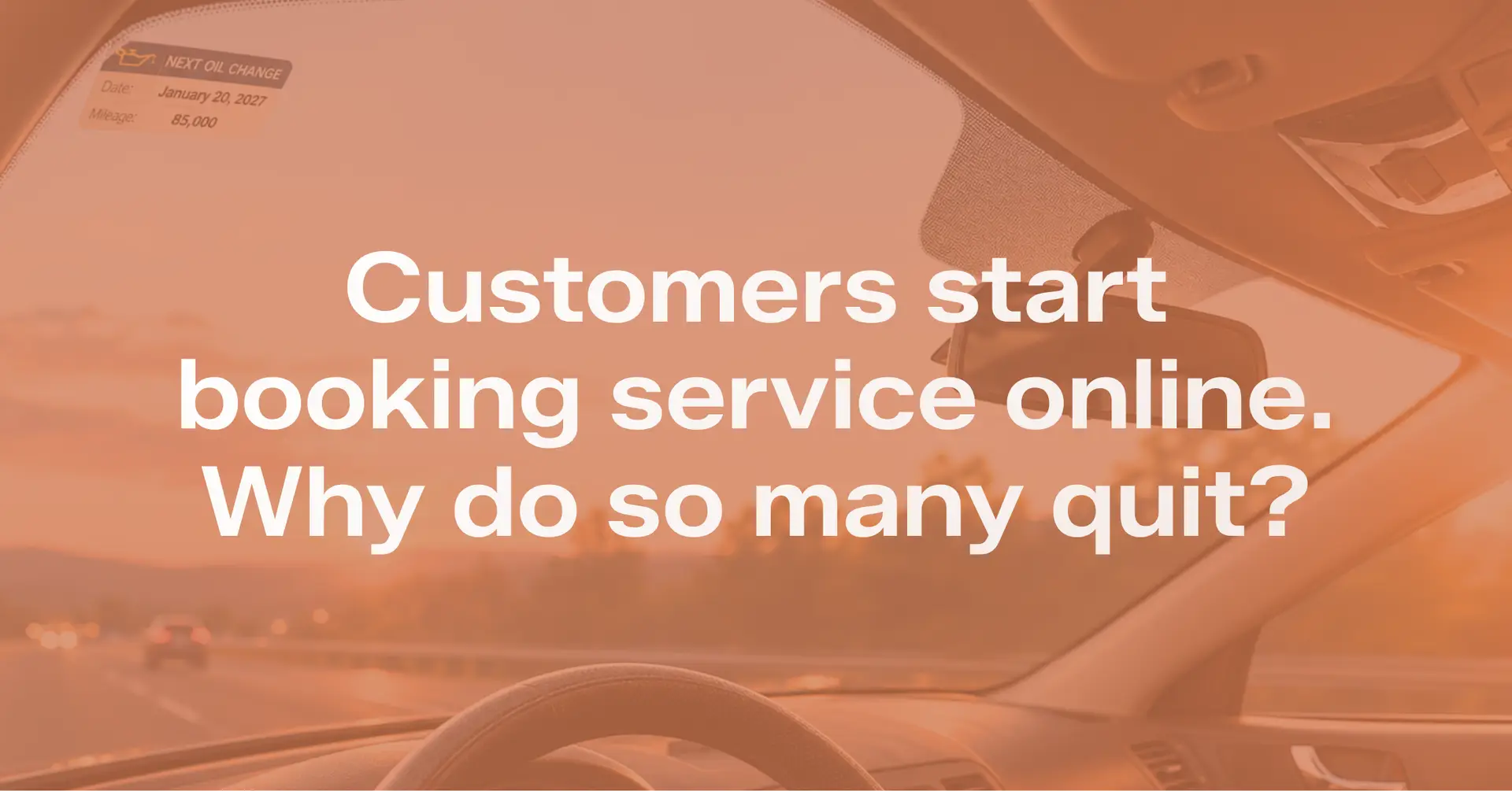
Picture one of your customers in the school pickup line with ten minutes to spare. The sticker on her windshield says she’s a few hundred miles past due for her first oil change since buying the car, so she opens your site on her phone and taps Schedule Service. The form wants a login she doesn’t remember making. It can look it up by VIN but getting that information is very inconvenient.
She sighs. Closes the window. And later that week she goes to a shop nearby the school, and you’ve just lost a service customer and a potential repeat buyer.
Where do customers drop out of online service booking?
They drop out where the booking asks for effort before it shows them anything useful: finding the tool, filling in fields, and finding a time. Here’s what that looks like on a phone.
- Finding the button. Customers want Schedule Service where their thumb already is: the top of the mobile page, the Google profile, the service reminder text. When it sits two menus deep, a share of people never start.
- Fields before times. A login, a password, a mileage reading or a list of services to pick from, all before a single open slot appears. Every screen is one more chance to put the phone down.
- No time that fits. Most customers booking online want this week. In Pied Piper’s October 2026 study of the 31 largest U.S. dealer groups, shoppers at the six top groups could book online no later than one week out 93% of the time on average, compared with 73% at the four lowest.
- The page just doesn’t work. In Pied Piper’s 2026 Service Scheduling Effectiveness study (6,538 phone and website requests across 33 brands, reported September 2026), website scheduling failed 5% of the time industrywide. By brand, the failure rate ran from under 1% to 31%.
What does a dropped online booking cost the service department?
A dropped booking turns into a phone call your advisors have to take, or a visit to someone else’s bay. Either way, there was already energy spent in trying to get that customer back. Whether they were booked at the time of sale, your BDC attempted to call them, you ran an ad to get them back to you…it’s all wasted effort if you don’t make it easy for the customers you’re reaching to take action.
This goes for your phones too. Pied Piper’s dealer group study (October 2026) found that about two thirds of service customers still schedule by telephone. First, if your phones are booking more appointments than your scheduler, there is a high chance your scheduler is hard to work with. Second, for the customer that doesn’t call when the scheduler fails them, two things can happen: they show up anyway, usually right in the middle of the 8am rush, or they book with a shop that made it easier.
Cox Automotive’s Service Industry Study (released November 2025) names “easy scheduling” and “flexible service options” as what owners want, and 71% of customers in the study ranked online scheduling as the most important feature a dealer can offer. Cox also names after hours scheduling as one of the conveniences that wins customers back. Your website is the only booking channel open at 9pm on a Sunday. When it stalls, nobody is there to catch it.
What are dealers trying to fix it?
Most stores start by putting booking links in more places, then find the real bottleneck sits inside the booking flow itself. Here’s what stores commonly try:
- More links. Booking links on the Google Business Profile, in service reminder emails, and in every text from an advisor.
- Asking for a shorter form. Requesting fewer fields or a different order of steps, which most scheduling systems don’t let a store change.
- More online capacity. Opening more appointment slots to online customers instead of holding them for the phone.
- Steering people to call. Some stores quietly push customers back to the phone, which adds to the load the website was supposed to take off the counter.
- Adding voice AI to the phones. An AI agent answers every service call, books the routine appointments and catches after hours callers, which takes real work off your advisors and BDC. It’s worth doing for that reason. It just doesn’t change the online booking, so customers who’d rather book on their own still land on the same underperforming form.
More links help only if the page they lead to is quick to finish. A link that sends more people into a seven screen form just means more people quitting at screen four.
What makes customers finish an online service booking?
Customers finish when they see open times fast, type only what you don’t already know, and get a confirmation they can act on. Most scheduling systems don’t let a store rebuild their screens, so these moves usually come from a booking layer in front of the scheduler that hands each appointment straight to it.
- Put the button where the customer is. Top of every mobile page, on your Google profile, and in every service text and email.
- Show times before you ask questions. Recognize returning customers by phone number and pull their vehicle from your records, so they confirm instead of type.
- Open real availability this week. Spread online appointments across the day so 8am doesn’t fill while the bays sit empty by 2.
- Confirm by text and email, with an easy way to change it. In Pied Piper’s 2026 dealer group study, the six top groups sent email and text confirmations 86% of the time on average, compared with 26% at the four lowest. At the lowest groups, 26% of customers had no clear way to cancel or change their appointment.
- Measure starts, not just bookings. Track how many customers start a booking and how many finish, every month. That one ratio tells you whether the fixes above are working.
So what’s the thread that holds this together? Every step either respects the customer’s ten minutes or spends them.
Where does BLiNK AI fit?
BLiNK’s Scheduler sits on top of the scheduler you already use and lets customers book from your website, Google, or a text in as few as five clicks. It never replaces your scheduler, and appointments spread across the day so the morning doesn’t jam. Every field you add is your call, so the booking stays as short as you keep it.
Stores see an 83% increase in web appointments with BLiNK’s scheduler, and online booking conversion runs 2 to 3 times the market average. From January to September 2026, customers booked more than 680,000 service appointments online through BLiNK AI across all brands.
FAQ
What’s a good completion rate for online service booking?
Track your own starts and finishes monthly, because that trend tells you more than any single benchmark. For reference, online booking conversion with BLiNK Scheduler runs 2 to 3 times the market average.
Do customers still prefer to call for service appointments?
Many do: about two thirds of service customers still prefer to schedule by phone, according to Pied Piper’s 2026 dealer group study. That makes online booking the channel for everyone else, especially after hours, when the phone isn’t an option.
Should online service booking require customers to create an account?
Customers finish faster when they don’t have to. Recognizing returning customers by phone number and pulling their vehicle from your records gets them to the calendar without a password.
How far out should online service appointments be available?
Within the week, whenever you can. In Pied Piper’s 2026 dealer group study, the six top groups offered an online appointment no later than one week out 93% of the time on average, compared with 73% at the four lowest.
Does online booking take work away from advisors or the BDC?
It takes the routine bookings off the phone so your team can spend time on the conversations that need a person. Customers who want to call still can.

Sources
- Pied Piper 2026 Service Scheduling Effectiveness (SSE) Auto Industry Study, as reported by CBT News, September 15, 2026: Service scheduling improves industry wide
- Pied Piper Service Scheduling Effectiveness (SSE) Auto Dealer Group Study, October 2026, as reported by AutoSuccess: article
- Cox Automotive 2025 Service Industry Study (71% rank online scheduling first; owner quote and after hours scheduling from the November 11, 2025 press release): press release (PDF)
- BLiNK platform data, January to September 2026, all brands, rounded down